
The Single Lamp
An evening practice for people who light their rooms from the ceiling, and what happens to a room when you stop.

There is a small lever on the wall of my apartment, beside the door, that I press perhaps a thousand times a year without thinking about it. It turns on the overhead light.
The overhead light in my main room is a flat circular LED panel set into the ceiling, the kind that came with the apartment and that exists in, I would guess, several million Tokyo apartments built in the last twenty years. It has three settings. The brightest is the colour of a convenience store at two in the morning. The dimmest is still brighter than any room my grandmother ever sat in. There is a small remote for it on the table, which I have lost twice.
For most of the years I have lived here, this light was simply “the light.” When it was dark outside, I pressed the lever, and the room turned on. I did not think of it as a decision. It was the same gesture as turning on a tap.
About two years ago, I stopped pressing the lever in the evening. I want to write to you about what happened to the room when I did, because it turned out to be one of the largest small changes I have made, and because it costs nothing, and because it can be undone in one second if you hate it.
The overhead light is not neutral
Most of us treat the overhead light as the default, neutral, “correct” way to light a room. More light is assumed to be more useful, more cheerful, more safe. A dim room reads, in the modern imagination, as a room where something is slightly wrong — someone is depressed, or asleep, or saving money, or hiding.
This assumption is very recent. For almost all of human history, the light in a room after dark came from a small number of low, warm, local sources — a fire, a candle, an oil lamp, a single bulb. The room was mostly dark, and a small part of it was lit, and people arranged themselves and their evenings around that lit part. The flood of even, shadowless, ceiling-high light that most of us now live inside every evening is, historically speaking, a few decades old. We have not had time to notice what it does to us, because to us it is simply what a lit room looks like.
I am not going to make the argument that the old way was beautiful and the new way is ugly. That argument has been made, most famously by Tanizaki, and I have written about it elsewhere. This letter is not about beauty. It is about attention, which is the actual subject of this newsletter, and which the overhead light quietly works against.
Here is the claim, stated plainly. A room lit evenly from above asks nothing of your attention, and gives nothing back to it. A room lit by a single low source asks your attention to settle somewhere, and rewards it when it does. The overhead light makes the whole room equally available, which is another way of saying it makes no part of the room matter more than any other. The single lamp makes one part of the room matter, and lets the rest recede. This is, at the level of a room, the same discipline I keep writing about — the practice of staying with one thing rather than scanning everything.
What I actually do
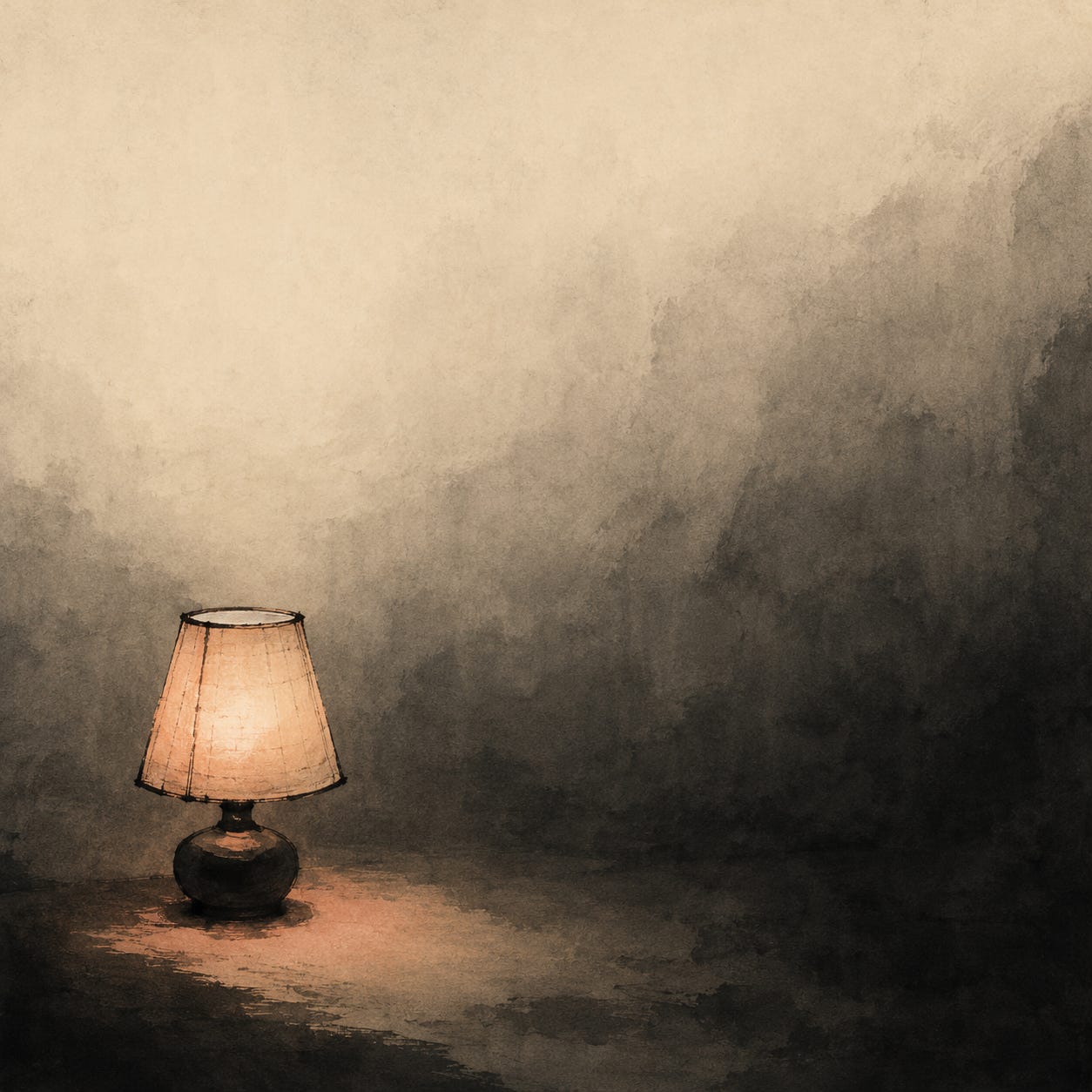
The practice is almost embarrassingly simple. When it gets dark, I do not press the lever. Instead I turn on one lamp.
In my case it is a small floor lamp with a fabric shade that I bought for about four thousand yen, standing beside the chair where I read. It throws a warm pool of light over the chair, the small table beside it, and about a square meter of floor. The rest of the room — the kitchen counter, the far wall, the ceiling I cannot see anymore — goes quiet.
That is the entire practice. One lamp, low, warm, in the part of the room where I am actually going to be. The overhead light stays off until I genuinely need it — to find something I have dropped, to clean, to do a task that requires me to see the whole room at once. Then I turn it on, do the task, and turn it off again. It has gone back to being a tool rather than a default.
The first evening I tried this, the room looked wrong. It looked dim, slightly sad, like the apartment of someone who could not afford electricity. I want to be honest that this feeling is real and that it lasts about a week.
What changes, and how long it takes
What changes is not the room. What changes is what your eye does inside it.
Under the overhead light, my eye used to do nothing in particular. The room was a flat, even field, and my attention drifted across it the way it drifts across a screen — everywhere and nowhere. Under the single lamp, my eye has somewhere to be. It rests in the lit pool, on the book, on the cup, on the grain of the small table, and the dark edges of the room stop pulling at it.
I read more slowly under the single lamp. I look at my hands more. When I drink tea, I look at the tea. The food on the plate, lit from one side, has shape and shadow instead of the flat even appearance it has under the ceiling panel. The room has become, for the evening, a smaller and more specific place — which is exactly the kind of smallness I have been trying to build into this apartment from the beginning.
The adjustment takes about two weeks. For the first week the room reads as too dark. By the second week your eyes have adapted — the human eye is extraordinarily good at this, and adapts downward far better than we expect, because we almost never give it the chance. By the end of two weeks, walking back into a room lit by the full overhead panel feels like walking into a parking garage. It is too much. You did not know it was too much because you had never turned it down long enough to find out.
The switch as a threshold
There is one more thing the single lamp does, and it is the part I did not anticipate.
Turning off the overhead light has become the gesture that ends my working day.
When I work in the evening — and I often do — I use the overhead light, because work wants the whole room available and the flat brightness suits it. But when the work is done, I turn off the overhead light and turn on the single lamp, and the room changes character in one second. The bright, even, task-shaped room becomes the dim, local, restful room. My nervous system has learned, over two years, what that change means. It means the day’s making is finished. It means I am allowed to stop.
This is the part I would most like you to try, if you try nothing else. Living alone in a city, the hardest line to draw is the one between the part of the day that is for doing and the part that is for being. There is no commute to mark it, no door that closes behind you. The light can be that door. The overhead light is for the day. The single lamp is for the evening. The switch between them is a threshold you cross on purpose, every night, with your own hand.
A small experiment, if you want to try
For two weeks, after dark, do not turn on the overhead light in the room where you spend your evening. Turn on one low lamp instead, placed where you actually sit. Keep the overhead light for tasks that genuinely need it, and turn it off again afterward.
Do not judge the practice in the first week. The first week is your eye protesting a brightness it has been given every night of its adult life. Judge it at the end of the second week, when your eye has adapted and the full overhead panel has started to look like too much. Then decide.
You may decide you prefer the overhead light. Some rooms, some lives, some eyes genuinely do. The point was never the dimness. The point was making the choice at all — turning the light from a thing that happens to you into a thing you do, once a night, on purpose.
If you try the two weeks, write to me. Tell me which lamp, and whether the room came back to you. I read every reply.
— Tōan “Tokyo, Sunday evening, one low lamp on.”
I want to thank you for making the space to notice and think in detail about these small things that matter. I am learning to slow down, to make space for the mind to do what it can when not crowded with tasks and concerns. This post explained so well what I experience in my quiet room, where the overhead light is rarely lit. I thank my grandparents for the instinct. I am looking again at what I have simply accepted as preferable, without really knowing why.
This comment was made in an effort on my part to help someone understand how I saw the besuty of this piece.
But, it also belongs here:
I think, maybe, the point the post’s author is making is that it is the meditative quality of noticing – that deep, intense feeling of being in contact with the world about you, regardless of what you notice.
Which clearly, a more rational and analytical approach would not achieve, other than a list.
As I understand it, there is an humbling act to be pursued here by meeting the world as it is and not as how one wishes it to be.
Equally, it is not about noticing the same, each evening say, more the process of how you notice - a process that might not be the same from time to time.
Best, Chris.