
The 6 a.m. Window
A small daily practice for people who live alone in cities.

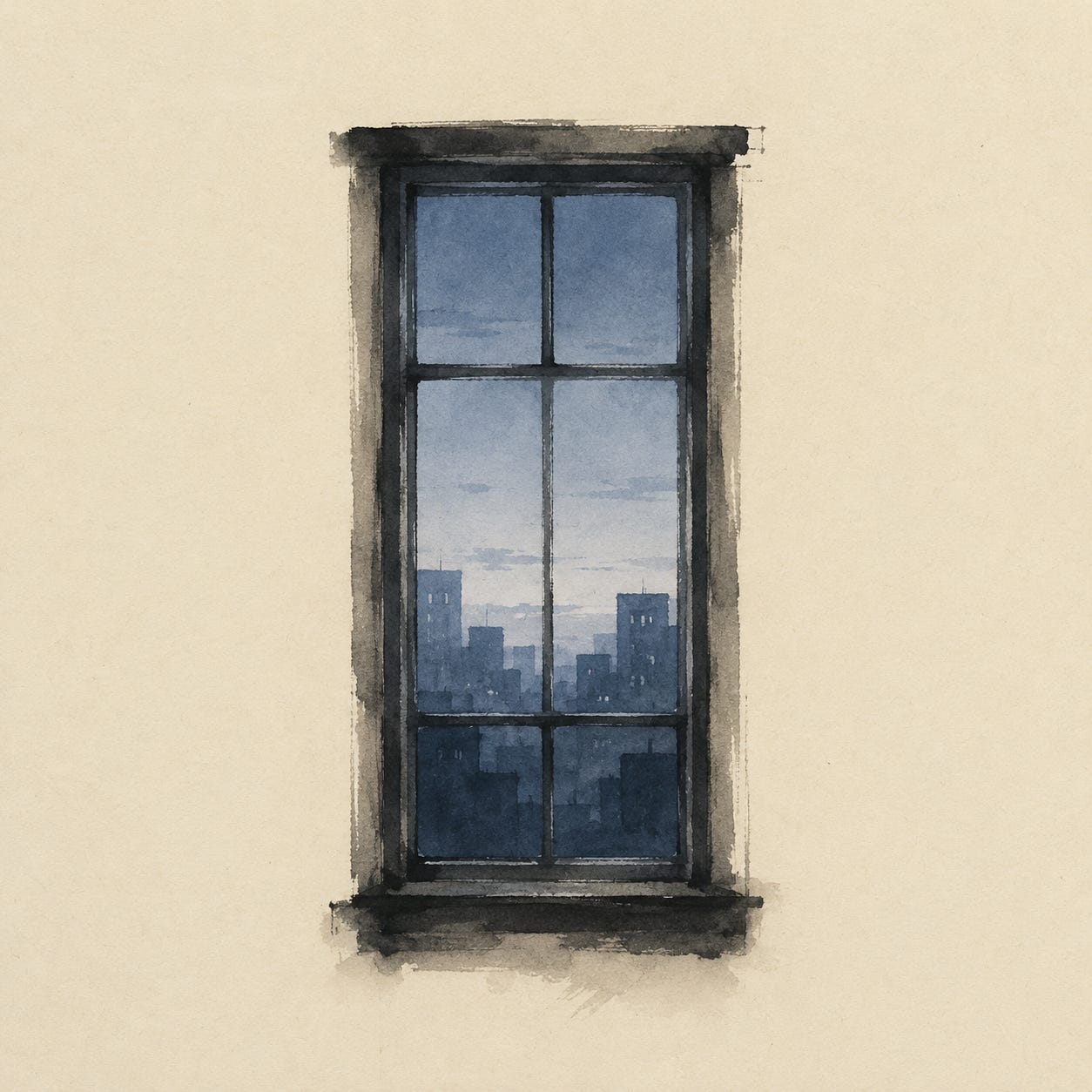
I want to write to you, today, about a single window.
It is the window in my Tokyo apartment, which faces the south side of another residential building approximately four meters away. The view consists of: a rectangle of pale concrete; the windows of the apartments opposite mine; a thin slice of grey sky visible above the building; and, depending on the season, two or three strands of vine that have crept up the gap between the buildings from a planter on the ground floor.
It is not, by any conventional measure, a good view.
For two and a half years, I have been standing at this window for five minutes every morning at six. No phone. No tea. No agenda. I just stand there.
I want to tell you what this practice is, why I started it, and what it has done.
### “Danshari” is a practice of attention, not a practice of disposal
Most foreign articles about “danshari” (断捨離) describe it as a stricter, more philosophical version of decluttering — three kanji that translate, roughly, as “refuse, dispose, separate”. The articles emphasize the verbs of “removal”. They describe a marathon weekend of going through possessions and discarding ruthlessly.
This is not wrong. But it is incomplete in the same way that “mottainai” as “don’t waste” is incomplete, and I think the reason is structurally similar.
The deeper meaning of “danshari” — in the original Buddhist-yoga context from which the term was popularized in modern Japan — is closer to a “daily mental discipline of choosing what stays”. The act of disposal is the visible end of an invisible practice: “attention”. You can only “separate” (離) the necessary from the unnecessary if you have first practiced “seeing” what is in front of you.
The decluttering weekend treats “danshari” as a project. The original frame treats it as a habit of attention.
This distinction matters because most of us cannot keep doing decluttering weekends. We can keep, with much smaller effort, a daily five-minute attention practice.
The window is mine.
### What I do, exactly
At six o’clock, before I check my phone, before I make tea, before I do anything else, I stand at my window for five minutes.
The rules I have given myself are simple:
1. No phone, no notebook, no music.
2. Do not try to think about anything in particular.
3. Look at one specific thing — a window opposite, a strand of vine, the corner of the sky — for the entire five minutes.
4. When the five minutes are up, go do whatever you were going to do.
That is the entire practice.
The first week, I was bored. The second week, I was bored and also slightly anxious — five minutes is longer than it sounds when you are not allowed to do anything. The third week, something began to shift, and I want to describe it carefully because it is the actual point.
