
Ryōkan's Empty Bowl
On a wandering monk who owned almost nothing, and what his single bowl can teach a person with a full apartment and a full phone.

There is a story I distrust, and I want to begin with it because the distrust is the point.
A thief breaks into the hut of the monk Ryōkan, somewhere in the snow country on the western coast of Japan, late in the eighteenth century. The thief finds nothing worth taking. Ryōkan owns almost nothing — a few robes, a writing brush, a bowl. So Ryōkan gives the thief the clothes off his own back, and then, the story goes, sits in the cold and writes: “the thief left it behind, the moon at the window.”
It is a beautiful story. It is also exactly the kind of story that turns a man into a postcard, and I have come, over many years of reading him, to think that the postcard is the enemy of the thing.
Who he actually was
Ryōkan (良寛) lived from 1758 to 1831. He trained as a Zen monk, and then he did something that the institution did not really have a slot for: he left it. He did not become an abbot. He did not run a temple. He spent much of his life as a wandering, then a settled, hermit — living in small huts, begging for his food, playing with the village children, writing poems he mostly did not try to publish, and practicing a calligraphy so admired that people schemed to trick him into producing it.
He is, in the standard telling, the gentle fool-saint of Japanese Buddhism. He signed himself “Daigu” — “Great Fool.” He let the children win at games. He is quoted on a thousand inspirational images now, the way Chōmei and Tanizaki are quoted, with the same flattening.
What gets lost in the postcard is that Ryōkan’s poverty was not an accident he made beautiful. It was a decision he kept making, every day, for decades, against the same pull the rest of us feel. He was not poor because he failed to acquire. He was poor because he had looked hard at acquisition and declined it, and then had to go on declining it, in the cold, when no one was watching and no thief was coming.
That is the version I find useful. Not the saint. The man who kept choosing.
The bowl is the whole argument
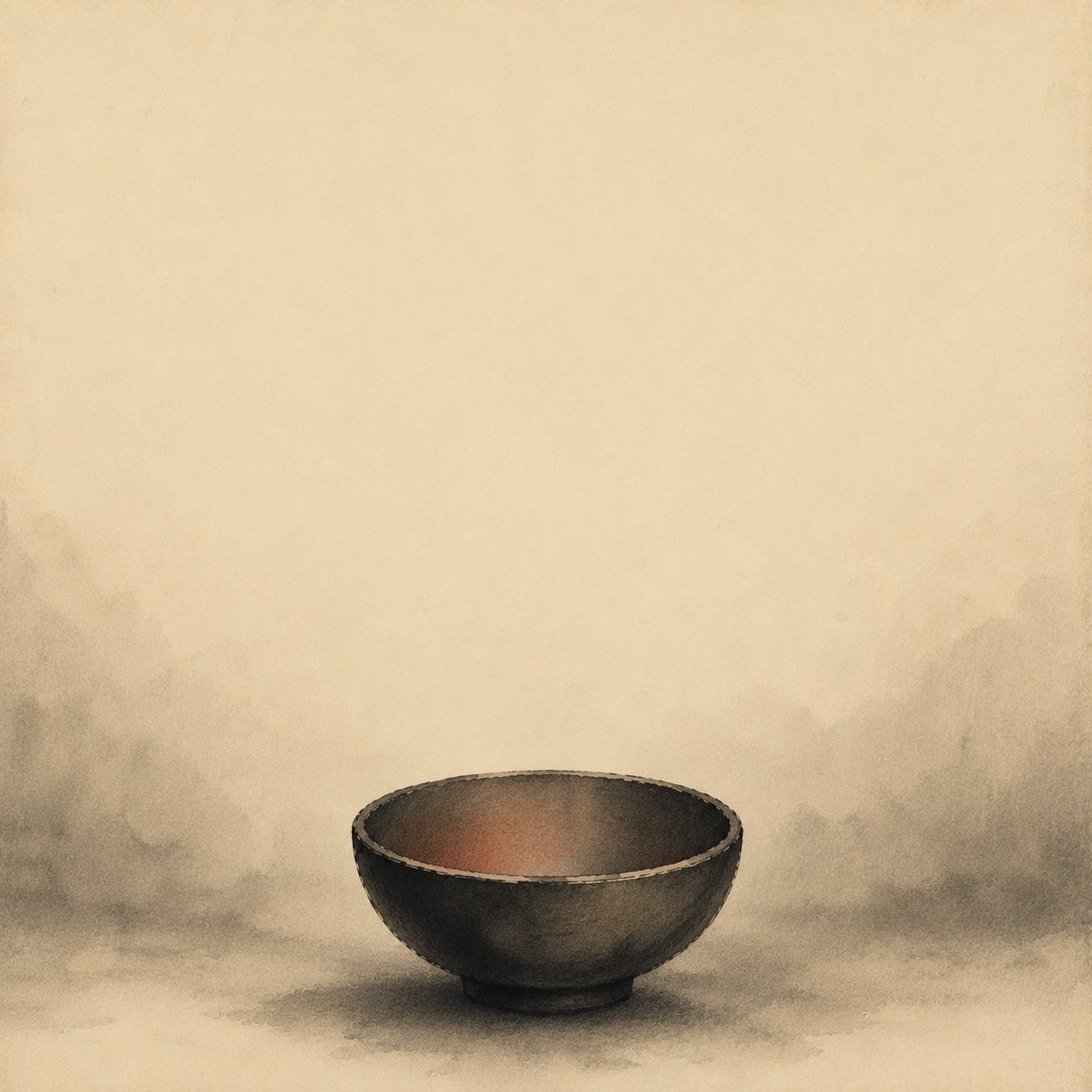
Of everything Ryōkan owned, the object that survives in the most stories is the begging bowl.
A mendicant monk’s bowl — the “ōryōki” tradition shrinks this to an exact discipline — is not a charity prop. It is, in the simplest reading, the one possession a person keeps when they have refused nearly all the others. You walk. You hold the bowl. People put rice in it, or they do not. You eat what is in it. You wash it. You carry it to the next day.
The bowl does several jobs at once. It is the tool of livelihood, the limit of appetite, and the daily proof that you do not need a cupboard. Its emptiness is not a lack waiting to be fixed. The emptiness is the working part. A full bowl is a meal. An empty bowl is the readiness to receive one. Ryōkan’s bowl was, in this sense, never really empty — it was always either holding today’s food or holding the shape of tomorrow’s.
I keep a cup I have used for nine years. I have written about it before. But the cup is mine in a way Ryōkan’s bowl was never his. The bowl was held lightly enough to be handed to a stranger. Mine, I would chase down a thief for. The distance between those two grips is the distance I am trying to close, one small inch at a time, and failing at, mostly, and trying again.
What the bowl is not asking of me
I want to be careful here, because this is where the postcard does its damage.
The bowl is not asking me to move to the snow country and beg. It is not asking me to give my clothes to a burglar. It is not asking me to admire poverty, which is one of the ugliest things a comfortable person can do — to aestheticize a condition that, for most people who live in it, is not a poem but a grind. Ryōkan chose his lightness from a position of being able to choose. So can I. So, probably, can you, in the small ways that are actually available to us. That choosing is the only honest part of the inheritance.
What the bowl is asking is narrower and harder than the postcard. It is asking: of all the things you keep “just in case,” how many are an empty bowl — held loosely, ready to be of use, free to be handed on — and how many are a full cupboard you have quietly started guarding?
The full cupboard is the natural state of an apartment in a wealthy city. I have a drawer of cables for devices I no longer own. I have a shelf of “just in case.” I have, somewhere, three of a thing I need one of, bought at three different times because I could not find the first two. None of this is sin. It is just weight. It is the opposite of the bowl. It is the cupboard I have started, without deciding to, to guard.
What this looks like in a Tokyo apartment in July
High summer is the wrong season to read Ryōkan, which is exactly why I am reading him now.
July in a Tokyo apartment is the season of too-much. The heat arrives and the urge to acquire arrives with it — a second fan, a cooling mat, a gadget that promises to make the twelfth floor bearable. The closet still holds the winter things, because putting them away properly is a task, and so they sit, guarded, in the heat, for a season in which they are pure dead weight. The phone, meanwhile, has its own version of the full cupboard: the apps I do not open, the subscriptions I do not use, the photographs of meals I no longer remember eating.
Against all of that, the bowl is a single, almost embarrassing question. “What, today, is actually being used?”
Not “what might be useful.” Not “what was expensive.” Not “what would be a waste to let go of” — that is mottainai turned upside down, the word weaponized into hoarding, which is its exact opposite. Just: what is in the bowl today, and what is the cupboard I have started to guard?
Three small forms
I have been practicing, badly, three small versions of the bowl. None of them require a hut.
The single vessel. Choose one object that already does several jobs in your life, and notice it on purpose. The pot that is also the bowl. The cloth that is also the bag. The cup that is also the measuring scoop. Ryōkan’s bowl was honored not because it was special but because it was sufficient. Find the sufficient thing you already own, and let it be enough for that job, on purpose, instead of buying its specialized replacement.
The returned thing. Once a week, take one object that you are keeping “just in case” and return it to circulation — give it, lend it, pass it on, let it go. Not a decluttering marathon. One thing. The practice is not the emptying. The practice is the loosening of the grip, repeated until the grip itself gets lighter.
The enough line. Write one sentence, for one category of object, that names what “enough” is. “Four mugs is enough.” “One coat is enough.” “Two of this cable is enough.” Then, when the impulse to acquire the fifth mug arrives — and it will — you have a line already drawn, in your own hand, from a calmer hour. Ryōkan’s whole life was a long version of this sentence, drawn once and then defended daily.
Why the fool kept the bowl
Ryōkan signed himself Great Fool, and I think the foolishness he meant was this: he kept choosing the empty bowl over the full cupboard, knowing the full cupboard was right there, knowing no one would have blamed him for it.
That is not saintliness. It is a discipline available, in small denominations, to a person on the twelfth floor with a full phone and a guarded closet and the July heat coming through the glass. You do not need to give your clothes to a thief. You only need to ask, of one drawer this week, whether it is a bowl or a cupboard — and to loosen your grip, by one object, on the cupboard.
If you find one thing this week that you can hand back to the world, write to me. I want to know what it was, and whether your hand was as slow to open as mine.
— Tōan
“Tokyo, the twelfth floor, Sunday, the first heat of the summer.”
Thank you. An avid reader of Ryōkan here...
Ryōkan's bowl.. In his Chinese poems he mentions that he found a bowl amidst high foliage. Perhaps the one he kept with his tattered robe, flask and cane...
So old no one even cares to steal it if left by the road. And so broken it becomes a beautiful receptable for violets.
You have turned his bowl into profound reflection. Thank you. (bow)
in my nomad days, when i travelled with a hammock & a sleeping bag & a poncho with corner grommets for a tarp, i whittled down my mealware to a wide cup (to eat & drink from), a knife, a fork, & a spoon. then one day i realized i could learn to eat with just the flat of a bread knife, & after that i gave away the fork & the spoon.